
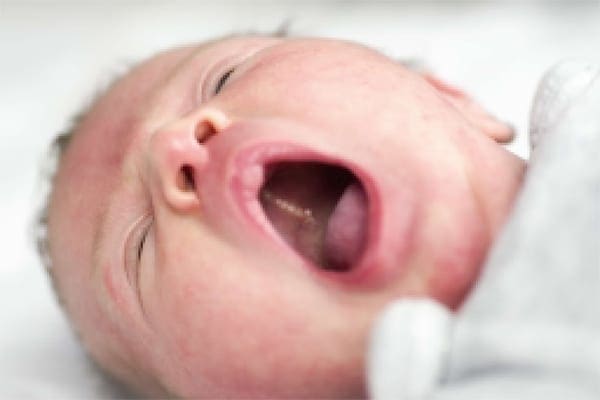
What are these white bumps in my infant’s mouth?
Fear not, new parents! In the midst of diapers, night feedings, and sleep deprivation, it probably caused your heart to sink when you noticed little white bumps in your baby’s mouth. While it may be alarming to see, it is most likely a harmless, common condition called Epstein’s Pearls. Good news! In fact, 80% of babies are affected, usually newborns up to 5 months, with most cases being newborns.
What are they?
- They are round or oval, whitish yellow, raised areas on the gums where the teeth will be, or on the roof of the mouth. They are 2-3 millimeters in size.
- They are formed in utero when a baby’s jaw and palate are coming together, leaving little bits of extra skin caught in a cyst.
- Since they are white swellings on the gums, sometimes they are confused for baby teeth. Generally, the first baby teeth are the lower middle incisors, coming in at around six months. Epstein Pearls are often present at birth or in the first few weeks. Occasionally some babies are born with teeth (which can really interfere with feeding!), so if you are unsure, let us or your pediatrician take a look.
Should I be worried? - Nope! Even though they look alarming, epstein pearls are painless and not a sign of infection. They usually resolve within a few weeks, wearing down through the baby’s nursing or feeding habits. Most cases are completely gone by the time the baby is 5 months old.
- These are normal and there is not anything that you did to cause them!
- Do not try to pop these cysts as that can be painful for the baby and they will resolve on their own. You also want to avoid breaking the skin and allowing bacteria into the bloodstream. Leave it be and just snuggle your little one instead.
When to make an appointment. - If your baby is fussy and appears to be in pain, call us or your pediatrician.
- If the lesion persists longer than a month, make an appointment to rule out any other oral conditions.
- If you see white patches instead of round raised lesions, talk to your pediatrician because your baby may have thrush and not epstein pearls.
- Call for an appointment if there is any issue feeding.
- We are here for you if you have any concerns at all! We would love to meet your baby and take a peek! (We REALLY love babies!)
Sources and further reading:
https://www.verywellfamily.com/what-to-know-about-epstein-pearls-4163059
 Skip to content